

/…/
—
Global warming happens when the Earth becomes warmer because heat stays in the atmosphere.
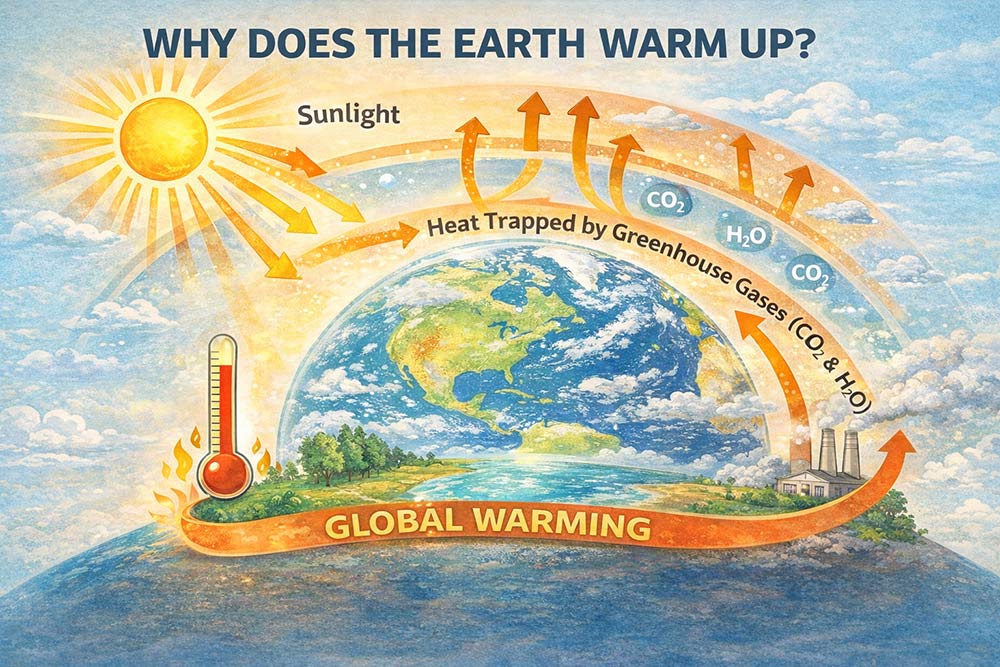
Sunlight passes through the atmosphere and warms the Earth's surface. The atmosphere is the air that surrounds the Earth.
Air is made of:
The Earth's surface and the oceans absorb energy from the Sun and become warm. They then warm the air around them. Some of this heat goes back into space, but some stays in the atmosphere.
Gases such as carbon dioxide and water vapor trap some of the heat that would otherwise escape into space. This helps keep our planet warm.
Even though carbon dioxide makes up only about 0.04% of the air, it is very good at absorbing heat. Because of this, it has a strong effect on the Earth's temperature. This is called the greenhouse effect.
Another words, the greenhouse effect is when the atmosphere does not allow all of the Earth's heat to escape into space, but keeps part of this heat near the planet's surface.
Heat is spread around the planet by moving air. The atmosphere always tries to equalize air pressure, which is formed because the Earth's surface is heated unevenly, so air moves from areas of high pressure (usually colder places) to areas of low pressure (usually warmer places). This movement of air creates wind and helps move heat around the Earth.
When there are too many greenhouse gases (such as carbon dioxide and water vapor) in the atmosphere, they trap too much heat. As a result, the Earth's average temperature rises. This is called global warming. Now, the average temperature of the Earth is about 15°C.
Global warming is dangerous because it can cause glaciers to melt, sea levels to rise, and some areas of land to be flooded.
LISTEN TO THE TEXT
За полгода вывожу ученика начального уровня на уровень уверенного общения, свободного выражения своих мыслей. Специализируюсь на экспресс-методах обучения.

 Как правильно изучать английский язык по карточкам (статьи)