

/…/
—
Snow falls when water vapor freezes in cold air and turns into ice crystals.
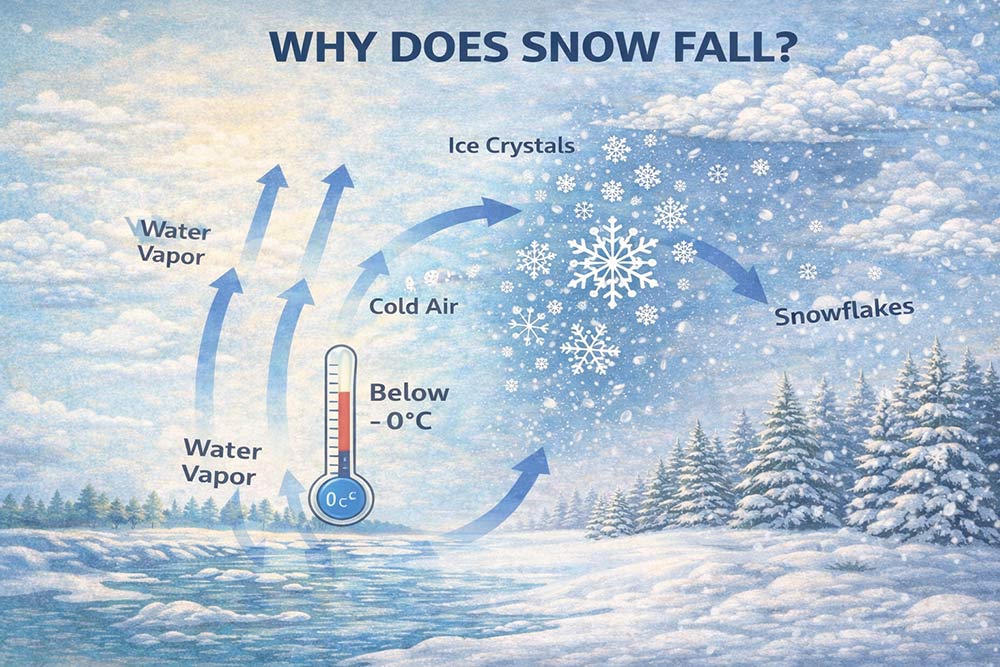
The Sun heats rivers, lakes, seas, and oceans. Because of this, water evaporates and turns into water vapor. The vapor rises high into the atmosphere and slowly cools.
Warm air can hold more water vapor than cold air. As the air cools and the temperature falls below 0 °C, some of the water vapor begins to turn into tiny ice crystals.
These ice crystals bump into each other and stick together, forming snowflakes.
As snowflakes collide with more crystals, they become larger and heavier. When they become too heavy for the rising air to hold them, they fall to the ground as snow.
If the air temperature near the ground is below 0 °C, the snow reaches the ground and does not melt. If the air temperature near the ground is above 0 °C, the snowflakes melt and turn into rain.
It is also important to know that water evaporates in every season. Even in winter, water continues to evaporate, although much more slowly. For example, if you hang wet clothes outside to dry at −10 °C, they will still dry over time, but it will take much longer. In addition, ice and snow can change directly into water vapor without becoming liquid water first. This process is called sublimation.
Because of this, heavy snowfall can form from water that evaporated nearby or from water that evaporated over seas, oceans, lakes, and rivers hundreds or even thousands of kilometers away.
LISTEN TO THE TEXT

За полгода вывожу ученика начального уровня на уровень уверенного общения, свободного выражения своих мыслей. Специализируюсь на экспресс-методах обучения.



 Как правильно изучать английский язык по карточкам (статьи)