

/…/
—
In this article, we will learn how life came from inorganic matter, how the first cells appeared, and why we are made of stardust.
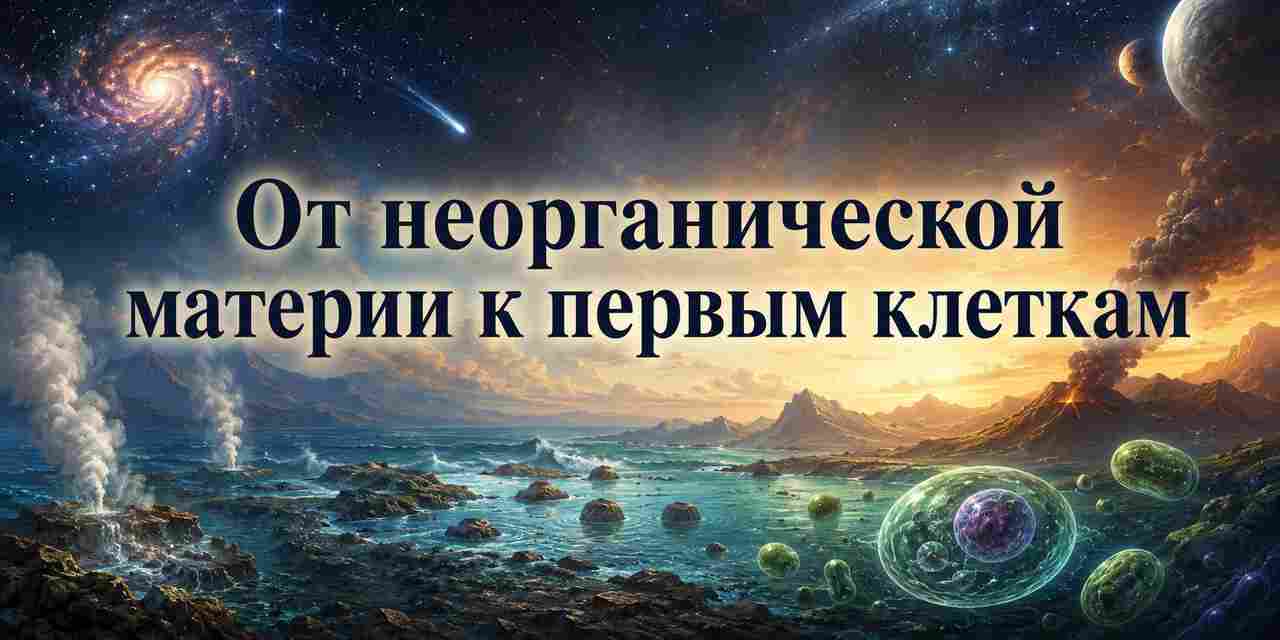
In the previous section, we talked about inorganic matter and chemical elements that were formed as a result of processes that happened after the Big Bang and inside stars.
Everything started with elementary particles: protons, neutrons, and electrons. In the first minutes of the Universe's existence, protons and neutrons formed the nuclei of hydrogen and helium. Later, inside stars, thanks to thermonuclear reactions, heavier chemical elements began to form. Later, planets and all life on Earth formed from these elements.
But the next question arises: how did organic matter appear from inorganic matter?
Organic substances are substances that are based on carbon atoms. Organic substances include proteins, fats, carbohydrates, amino acids, DNA, and many other compounds that make up living organisms.
Modern science believes that the first organic molecules could have appeared naturally from inorganic substances. On the young Earth, there were water, carbon dioxide, nitrogen, methane, and other simple compounds. Over time, more complex organic molecules formed from them.
One of the most important such molecules were amino acids — the building blocks of proteins.
Scientists have found amino acid molecules in meteorites, comets, and interstellar clouds. This means that some building blocks of life can form not only on Earth but also in space. However, amino acids and even proteins are not yet life. Scientists still do not know exactly how the first living cell came from complex organic molecules.
Proteins are still far from being life.
Here is a simple example:
Proteins are huge and quite complex molecules made of tens, hundreds, or even thousands of amino acids. So far, in space, scientists mainly find:
The exact mechanism of the transition from inorganic matter to the first living cell still remains one of the biggest mysteries of science. However, scientists have already proven that many organic substances can form naturally without the involvement of living organisms.
So, the first living cell probably appeared on Earth about 3.5–4 billion years ago. Considering that Earth formed about 4.5 billion years ago, life appeared relatively quickly — only about 500 million years after our planet appeared.
Science does not yet have an exact answer as to where exactly this happened. One of the most popular hypotheses is hot hydrothermal vents on the bottom of ancient oceans.
The first cells were very simple. They were prokaryotes, meaning organisms without a cell nucleus. They had no nucleus, no mitochondria, and no other complex internal structures. Such organisms resembled modern bacteria.
Despite their simplicity, they already had the main properties of life: they could get energy from the environment, store hereditary information, and make copies of themselves through division.
It is assumed that the first cells had a membrane that separated them from the environment, internal fluid, a set of proteins, and a molecule that stored hereditary information. Many scientists believe that before DNA appeared, a simpler molecule — RNA — could have performed this role.
DNA is a huge molecule that stores information about the structure, development, and function of a living organism.
When a cell divides, it first copies its DNA, and then passes a copy to the daughter cell. This way, new cells receive the same information as the parent cell.
It is from such simple cells that, over billions of years, all bacteria, plants, animals, and humans living on Earth today descended.
The first cells got building materials from the environment. In ancient oceans and hydrothermal vents, various organic molecules were already present that could be used by cells for growth and reproduction.
The first cells got energy from chemical reactions between substances dissolved in water.
Energy is the ability to do work. Without energy, a cell cannot build proteins, divide, move, or maintain its vital functions.
For example, when hydrogen combines with carbon dioxide, methane is formed and energy is released. Some microorganisms can use this energy for their life activities.
Since there was almost no free oxygen in the atmosphere at that time, these organisms did not use oxygen to get energy. So the first cells were anaerobic, meaning they could live and reproduce without oxygen. They were also prokaryotes — simple single-celled organisms without a nucleus.
Among prokaryotes, there were two large groups:
Common ancestor
                  |
      -------------------------
      |                       |
   Bacteria                Archaea
                                |
                           Eukaryotes
                                |
              Plants, animals, fungi
Archaea are not the next stage after bacteria, but a separate ancient branch of life. Today, it is believed that both bacteria and archaea have existed for almost as long as life has existed on Earth. On the outside, archaea and bacteria look similar: both groups consist of small single-celled organisms and have no nucleus. However, at the molecular level, they are very different.
It was from one of the ancient branches of archaea (Asgard archaea) that more complex cells — eukaryotes — later evolved. Eukaryotes are cells that have a nucleus. Later, plants, animals, and humans emerged from them.
LISTEN TO THE TEXT
За полгода вывожу ученика начального уровня на уровень уверенного общения, свободного выражения своих мыслей. Специализируюсь на экспресс-методах обучения.

 Как правильно изучать английский язык по карточкам (статьи)