

[Shack Forms] Init failed
PUNISHMENT AS A FORM OF CARE: WHY CHILDREN NEED BOUNDARIES
- Подробности
- 2066
 Punishment as a Form of Care: Why Children Need Boundaries
Raising children is a complex and multi-layered task. It is not only about passing on knowledge, but also about shaping behavior patterns, developing skills, and cultivating qualities that will later help a child adapt to society, build healthy relationships, and become socially successful.
Is punishment good or bad?
Very often, parents neglect behavior correction itself. When a child runs, shouts, jumps, does something dangerous or clearly inappropriate, adults frequently brush it off: “He’s just a child — why bother him?” There is also another widespread belief that justifies parental passivity: that punishing children is unacceptable because it is supposedly violence against a future personality, and that any punishment will inevitably lead to negative consequences. But is this really true?
When parents punish a child, they do so not to harm, but to help. Punishment in itself is not inherently bad. If punishment is removed entirely, the child is left alone with strong impulses while their reasoning is still weak. In a situation where logic competes with immediate desires, the child will almost always choose desire — because they are a child; they are not yet fully formed.
Different approaches and theories of punishment
There are, at times, radically opposing views on child punishment. One of the most popular sayings goes like this: “Up to five — a king; from five to fourteen — a servant; after fourteen — a friend.” As a rule, this so-called “ancient wisdom” is enthusiastically repeated by parents of children under five — as a way to avoid conflict with upside-down, uncontrollable offspring and to justify permissiveness by blaming the child’s age.
Others state bluntly: “We were beaten — and we grew up just fine. Nowadays you can’t even raise your voice at a child. We don’t care about new rules — we beat them and we’ll keep beating them.” However, consequences for such parents come quickly — especially if they live abroad, where even a slap or harsh words can result in losing parental rights. Many of our compatriots have faced this reality firsthand.
The world is built on limits
It is no coincidence that society imposes age restrictions: you can vote only from a certain age, full civil rights appear after eighteen, and driving a car is not allowed immediately. This is a recognition of a simple fact: a person is not yet ready.
So why do parental punishments in the form of restrictions provoke so many questions, if we calmly accept restrictions in all other areas of life?
Punishments come in many forms. One of the most effective and appropriate is the removal of something meaningful. Parenting is always built on two pillars: rewarding good behavior and withdrawing privileges for mistakes and violations. The classic scheme is simple: the child is warned once, then warned again, and if they consciously continue to break the rules, punishment follows.
The parents’ task is to help the child become an independent adult
Amid countless opinions, rules, and prohibitions, it is important to understand the main thing: the goal of parents is to prepare a child for adult life.
To ensure that, as they grow up, they can behave appropriately, possess skills valued by society, build healthy communication, and be useful — including professionally.
What does an “adequate” person mean? It is someone who is pleasant to interact with, who does not destroy the space around them but, on the contrary, brings joy to others. And this is not learned automatically — it is taught from childhood.
From an early age, society shows a child: this is allowed, and this is not. If a person systematically violates rules, there is a high probability that society will reject them.
And if parents do not punish a child, society will — but much more harshly.
Experienced parents explain it this way: “It’s not that we are bad. We also live by rules. Society lives by rules — otherwise there would be chaos. If you break them, there will be consequences. Right now, we punish you gently, because later society will punish you much more severely.”
In this case, the child does not feel injustice: they were warned, they made a choice — and they received the consequences.
The burden falls on parents
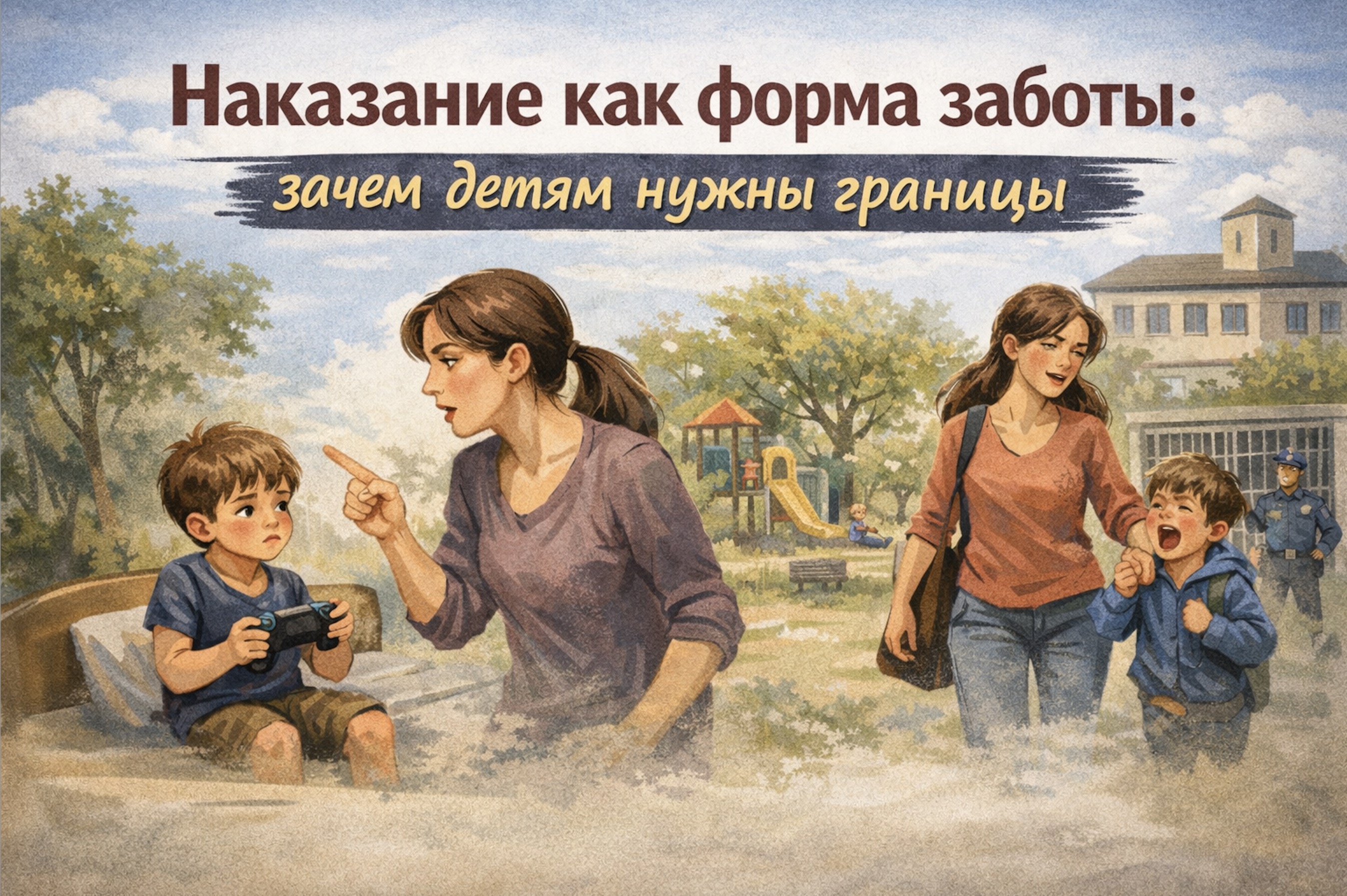
Recently, I witnessed a telling example at a playground. A mother calmly warned her son several times not to throw sand at other children. He ignored her.
Then she said, “If you do this one more time, we’re going home.” The child looked at her slyly — and immediately threw sand at another boy.
Without yelling, the mother picked him up and took him home. A tantrum followed: screaming, resistance, tears. But she followed through.
Later, I saw this child again — and he was calm and well-behaved.
One of the main problems in parenting is that parents are afraid to punish because they themselves don’t want to lose comfort or pleasure.
For example, a family plans a picnic for a long time, arrives, and suddenly the child starts behaving dangerously: running where they could fall, climbing where they could get hurt. They are warned, but the child doesn’t react — because they understand the parents have already arrived and won’t leave.
Competent parents in such situations are willing to cancel their plans. Yes, it’s disappointing. Yes, they were looking forward to the picnic. But safety and upbringing matter more.
Parental laziness and its consequences
Unfortunately, very often the absence of discipline and punishment is simply parental laziness disguised in various theories.
Many cling to ideas about the harm of punishment to justify inaction: “Let everything take its course — it will work itself out somehow.”
This approach is comforting in the moment, but in the long run it plays a cruel joke on parents.
My son attends jiu-jitsu classes, and I constantly see parents bringing in their “freely raised” children. These kids behave wildly and inappropriately: they don’t listen, disturb others, and disrupt training sessions.
Our coach is strict. For such behavior, he immediately removes the offender from training and sends them to the penalty bench.
Watching this, parents are almost in tears — but they can do nothing. At home, they never built a system where misbehavior leads to consequences, and now they are powerless in the face of the coach’s authority.
Another example I recently saw at an airport. It was crowded, electric carts were driving around, and attention was critical. Several out-of-control children started running, shouting, and jumping.
Strangers began to comment on their behavior. But to my surprise, the mother rushed to defend them: “They’re just kids — they’re just playing.”
Five minutes later, one of the boys slipped on a wet floor and split his eyebrow open.
He clearly wasn’t familiar with safety rules and didn’t understand that these rules exist primarily to protect him.
What a paradox. Trying to make life easier and avoid immediate discomfort, parents choose not to engage in upbringing — but in the end they face far more serious problems: injured children, conflicts with others, and complete helplessness in dealing with their own child, who ignores them and doesn’t hear their words.
Engage, not just punish
If a child becomes accustomed to ignoring prohibitions, they may get injured, poisoned, or end up in serious trouble.
For a child to start listening instead of tuning adults out, consequences must be real. Yelling and physical punishment work far worse than deprivation.
However, before resorting to extreme measures, it is worth trying to engage the child. Very often, destructive behavior is simply the result of boredom or the inability to occupy oneself.
Wise parents try not just to forbid, but to offer alternatives — showing how to play without disturbing others and redirecting energy into a positive direction.
When events are actually canceled several times in a row due to bad behavior, the child understands: the parents are not joking. If they said it, they mean it. And the child begins to listen.
Punishment anchored in the order of the world
If this does not help, punishment becomes necessary. But it must be applied not in the heat of emotion, but according to a clear scheme: warn, explain the reason, and refer to objective circumstances — the very “order of the world,” the rules and laws by which everyone lives.
Punishment should NOT be an emotional outburst by the parent. It should be a calm and inevitable consequence of the child’s own choice.
The most dangerous thing parents can do is threaten and then fail to follow through. This is a direct path to serious problems in the future.
Because later someone will say: “You can’t do this — it leads to prison,” and the person will already have family experience that says: “I was told ‘don’t’ before, I broke the rules, and nothing happened.”
A code word as an anchor of rescue
To help a child break out of an emotional freeze, parents can introduce a “code word.” This is a word or phrase that means punishment will be applied with 100% certainty if the bad behavior continues.
For example: “I’m sorry, but the order of the world forces me to punish you if you continue.”
It should be said calmly, without shouting. The key point is that the threat must be absolutely reliable.
If the child hears it and continues anyway, punishment follows immediately. After 3–5 repetitions, the child’s brain forms a connection: “The ‘order of the world’ is not an empty phrase — it really means losing something important.”
In an emergency situation — for example, when a child runs around a busy parking lot — this code word alone can be enough to activate their reasoning, pull them out of emotional chaos, and remind them of consequences.
Conclusion
For a person to develop a sense of law, they must encounter consequences for violations — in a safe, controlled form, within the family.
That is why parents choose a gentle but consistent approach: they warn in advance, offer alternatives, act without hysteria or emotional explosions, and explain that rules always apply.
Punishment does not begin at five years old, but at the moment when a child already understands what “good” and “bad” mean.
Children today develop faster, and many understand boundaries perfectly well by the age of three.
If punishment is logical, predictable, and explained, the child does not experience shock or a sense of injustice.
This is how an understanding of responsibility, law, and real life is formed.
Other articles by the author:
How to Raise Children: No “Magic Pill,” Only Clear Rules and Honest Consequences
Education and Critical Thinking: Why We Need to Change Our Approach
Обучаю разговорному английскому. Помогу Вам подготовиться к TOEFL или ЕГЭ.
За полгода вывожу ученика начального уровня на уровень уверенного общения, свободного выражения своих мыслей. Специализируюсь на экспресс-методах обучения.

- ИгорьRead more
Анонс статей
- Как легко и быстро выучить много английских слов: 12 способов
- Универсальный метод написания сочинений по ЕГЭ, TOELF или IELTS: лайфхак «Утверждение-Пример»
- Методики запоминания английских слов
- Как запоминать английские слова: 9 эффективных методов
- Интенсивность - главный фактор, определяющий успех в английском
- Учим английский по песням
- Способы изучения Неправильных глаголов
- ШКОЛА СОЧИНЕНИЙ ПО АНГЛИЙСКОМУ
- TOP 120 Неправильных глаголов по частоте испльзования №2
- Как легко запомнить 100 английских слов в день: 6 эффективных способов
- Как обучать детей английскому языку: 8 полезных советов родителям
- TOP 120 Неправильных глаголов СПИСОК + ТРЕНАЖЕР (по частоте использования)
 Как правильно изучать английский язык по карточкам (статьи)