

/…/
—
In this article, we will learn how the Universe appeared, how the first stars and planets formed, and why we are made of stardust.
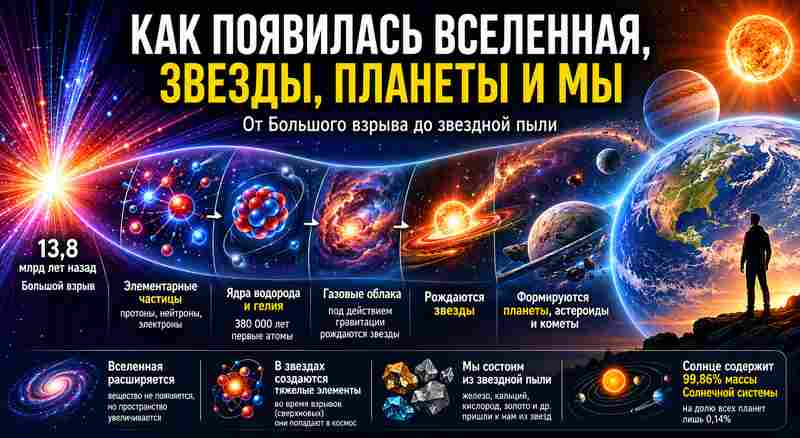
Probably, we need to start with how the Universe came from a very dense and hot state. For this, we should look at the Big Bang theory. According to modern ideas, about 13.8 billion years ago, the whole observable Universe was in an extremely dense and hot state, and then it began to expand.
After the Big Bang, the Universe was so hot that different elementary particles appeared in it: protons, neutrons, electrons and others.
When the Universe cooled a little, protons and neutrons began to join together, forming the nuclei of hydrogen and helium. About 380 thousand years later, electrons joined these nuclei, and the first atoms appeared.
Atoms are like the building blocks that everything around us is made of. By joining together through chemical bonds, atoms form molecules. For example, a water molecule, H₂O, consists of two hydrogen atoms and one oxygen atom.
And if we look deeper, modern physics believes that particles of matter came from the energy of the extremely hot early Universe. Science does not yet know exactly what was before that.
Hydrogen and helium began to gather into huge slowly rotating gas clouds. Under the force of gravity, these clouds compressed, their rotation sped up, and in their centers the first stars were born.
Huge clouds of hydrogen and helium slowly rotated and compressed under their own gravity. The more matter gathered in one place, the stronger the attraction between its particles became. When the mass of such a cluster became large enough, the pressure and temperature in its center rose so much that thermonuclear reactions started. That is how the first stars were born.
Not all matter fell into the star. Some of the gas and cosmic dust kept rotating around it, forming a huge disk. Over time, particles in this disk collided and stuck together, slowly forming planets, asteroids and comets.
For example, the Sun contains about 99.86% of the total mass of the Solar System. All the planets together make up only about 0.14% of the mass of the solar system.
Amazingly, one kilogram of the human body gives off thousands of times more heat than one kilogram of the Sun's matter. Then a logical question arises: why is the surface temperature of the Sun above 5000 °C, while the temperature of the human body is only about 36 °C?
The thing is that temperature and the amount of energy released are different things. Inside the Sun, thermonuclear reactions produce relatively little energy per kilogram of matter. However, the mass of the Sun is huge — about 330,000 times greater than the mass of the Earth. So even a small release of energy from each kilogram adds up to a huge total power. That is why the surface of the Sun is heated to about 5500 °C, and its center — to 15 million °C.
If Jupiter were about 75–80 times more massive, the pressure and temperature in its center would become so high that thermonuclear reactions turning hydrogen into helium would start there. In that case, Jupiter would turn into a second star, similar to a small Sun.
The amount of matter in the observable Universe is considered finite. As the Universe expands, the same amount of matter becomes spread over a larger volume of space. So the average density of matter gradually decreases, and the distances between galaxies grow.
Imagine a raisin cake. When the cake rises, no new raisins appear, but the distance between them increases. The Universe expands in much the same way: there is no more matter, but it is spread over a larger volume of space.
Inside stars, heavier elements were formed thanks to thermonuclear reactions. When massive stars ended their lives, they exploded as supernovae and threw these elements into space. Later, new stars, planets and other space objects formed from this matter.
That is why almost all heavy elements on Earth — oxygen, carbon, silicon, calcium, iron, gold and many others — were once created in stars and during their explosions. One could say that the Earth and all life on it are made of stardust.
The Universe appeared about 13.8 billion years ago, and our Solar System formed about 4.6 billion years ago. Billions of years before the Sun appeared, many first-generation stars had time to live their lives and explode as supernovae. During these explosions, huge amounts of gas and stardust containing heavy chemical elements were thrown into space. Later, from one such gas and dust cloud, the Sun, Earth and the rest of the planets of the Solar System formed.
We are literally made of the matter of long-dead stars.
So the iron in our blood, the calcium in our bones, the oxygen we breathe, and the gold in jewelry were once created inside long-dead stars or during their explosions. We are literally made of stardust.
LISTEN TO THE TEXT
За полгода вывожу ученика начального уровня на уровень уверенного общения, свободного выражения своих мыслей. Специализируюсь на экспресс-методах обучения.

 Как правильно изучать английский язык по карточкам (статьи)