

/…/
—
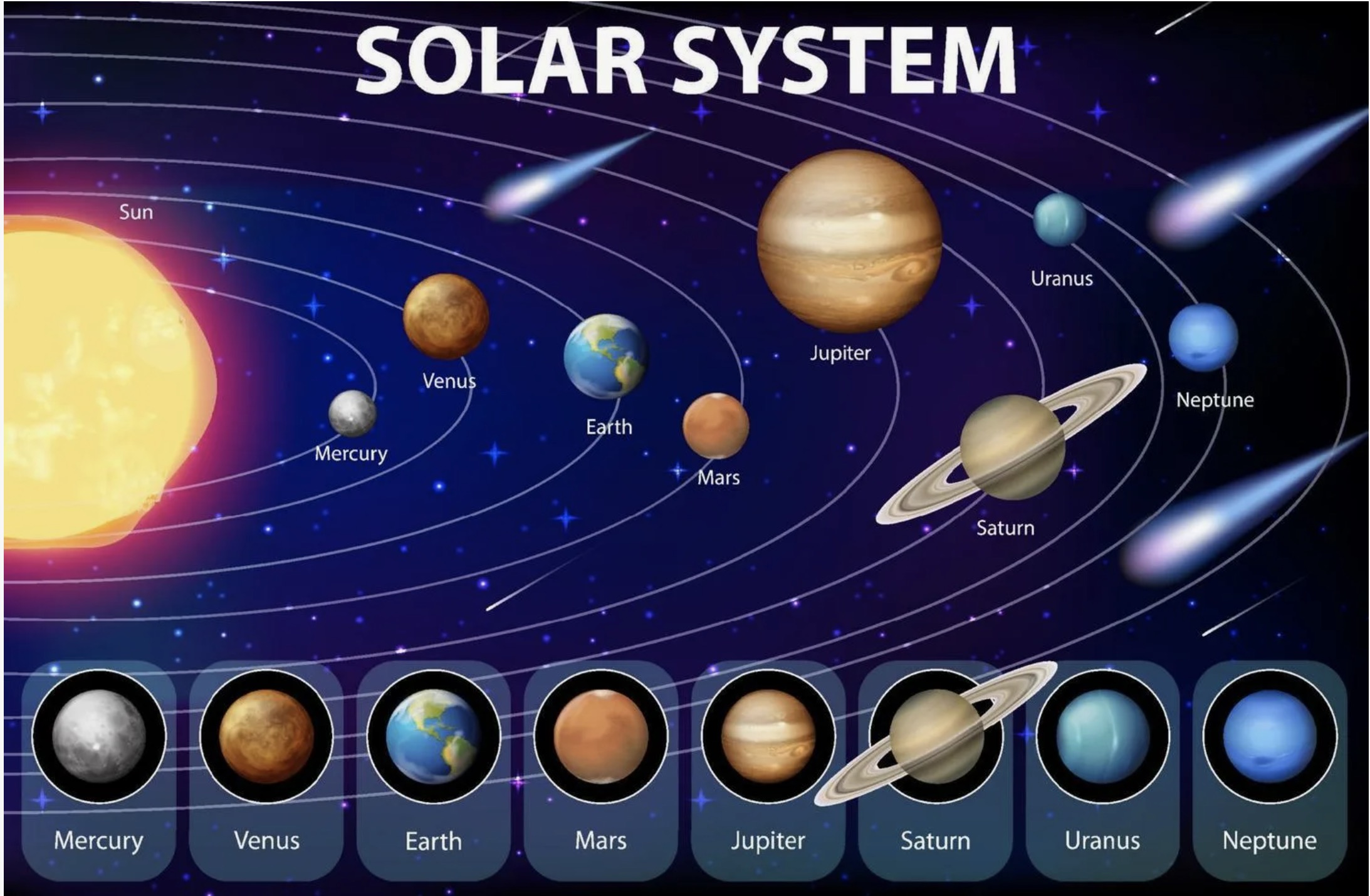
The Solar System has the Sun in the center. It has eight planets and many moons. There are also dwarf planets, asteroids, and comets.
The Solar System began about 4.6 billion years ago. It formed from a big cloud of gas and dust. Our Solar System is part of the Milky Way galaxy, which has hundreds of billions of stars.
At the center is the Sun. Its gravity holds everything in orbit. The Sun has almost all the mass in the Solar System (about 99.8%), so planets and other objects move around it.
There are eight planets: Mercury, Venus, Earth, Mars, Jupiter, Saturn, Uranus, and Neptune. The first four are rocky (terrestrial) planets. The last four are giant planets—two gas giants (Jupiter, Saturn) and two ice giants (Uranus, Neptune).
There are also dwarf planets like Pluto, Eris, and Ceres, many moons, and small bodies such as asteroids, comets, and meteoroids. These objects help scientists learn how the Solar System first formed.
Our whole Solar System moves around the center of the Milky Way at about 220 km/s (≈ 790,000 km/h) and needs about 230 million years to make one lap. The Milky Way itself also flies through space—about 600 km/s (≈ 2.2 million km/h) relative to the background of the universe.
LISTEN TO THE TEXT
The Sun is the center of our Solar System. It is a hot ball of gas that gives Earth light and heat. Inside, hydrogen turns into helium and releases energy.
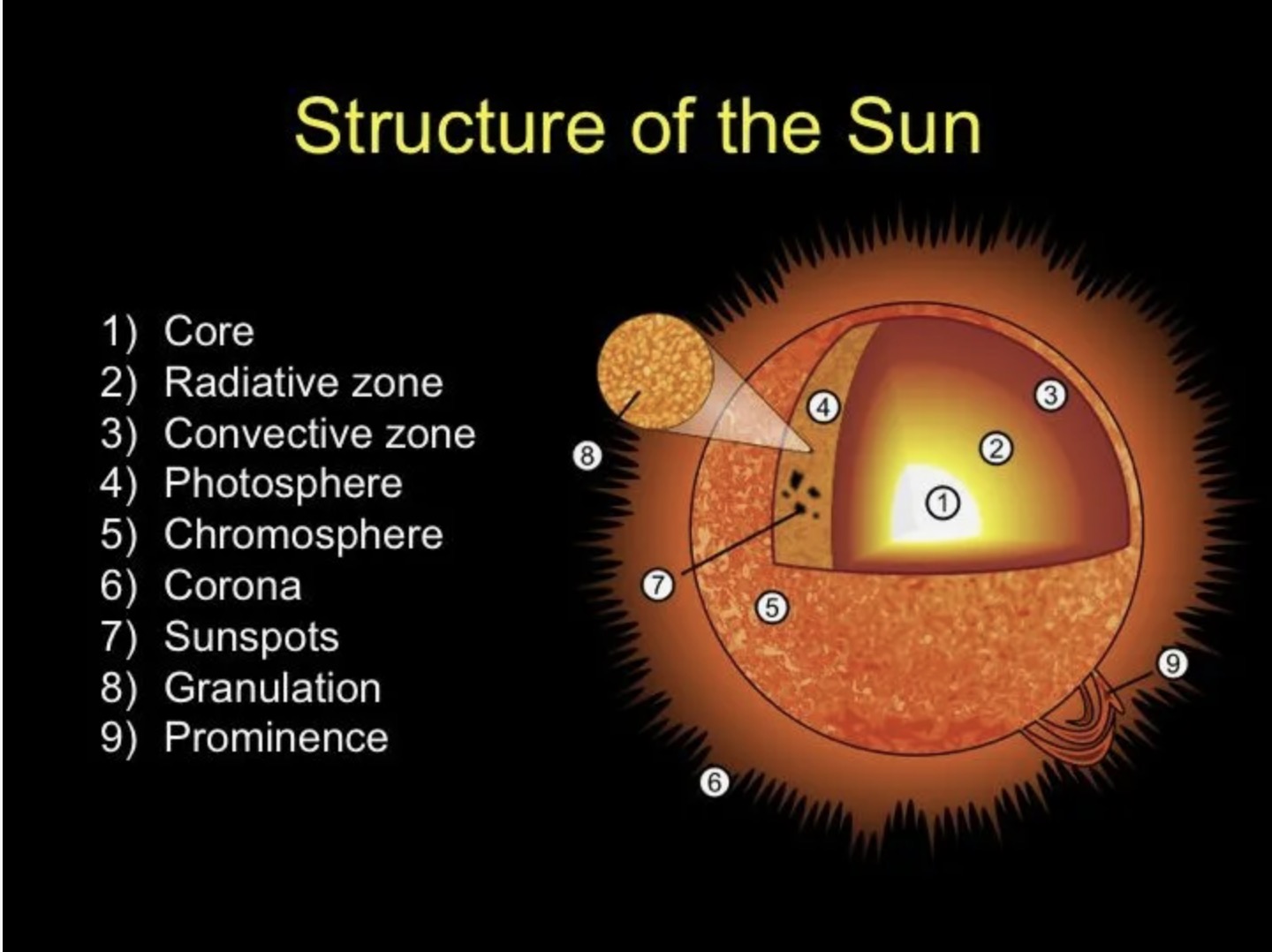
The Sun is the center of our Solar System, and all the planets go around it. The Sun is a medium-sized star, but it is the biggest object in our Solar System, so its gravity pulls everything toward it. Scientists think the Sun is about 4.6 billion years old. It gives us light and heat. The Sun’s diameter is about 1,392,000 km compared to Earth’s 12,742 km, making it roughly 109 times as wide as Earth.
Without the Sun, life on Earth could not exist. Plants use sunlight to make food and oxygen (this is called photosynthesis). Plants take in carbon dioxide, and animals and people breathe the oxygen plants make. The Sun keeps our world warm and bright so living things can survive.
The Sun is mostly hydrogen and helium. Deep in the center, tiny atoms join together in a process called nuclear fusion. This makes a huge amount of energy. The energy moves out to the surface and then into space as light and heat. The Sun also blows a stream of tiny particles called the solar wind. Core temperature of the Sun: about 15,000,000 K (≈ 15 million °C ). Surface temperature (photosphere): about 5,770 K (≈ 5,500 °C ).
The Sun is active. Sometimes darker areas called sunspots appear, and there can be bright solar flares. Big bursts of gas can fly into space. These events can make beautiful auroras near Earth’s poles and can sometimes bother satellites and radios.
People study the Sun with telescopes and space missions like SOHO, SDO, Parker Solar Probe, and Solar Orbiter. The Sun is about halfway through its life. In around 5 billion years, it will grow into a red giant and later become a white dwarf. For now, it shines every day and makes life on Earth possible.
LISTEN TO THE TEXT

За полгода вывожу ученика начального уровня на уровень уверенного общения, свободного выражения своих мыслей. Специализируюсь на экспресс-методах обучения.

 Как правильно изучать английский язык по карточкам (статьи)