

[Shack Forms] Init failed
WHY DO WE LEARN?
- Подробности
- 347
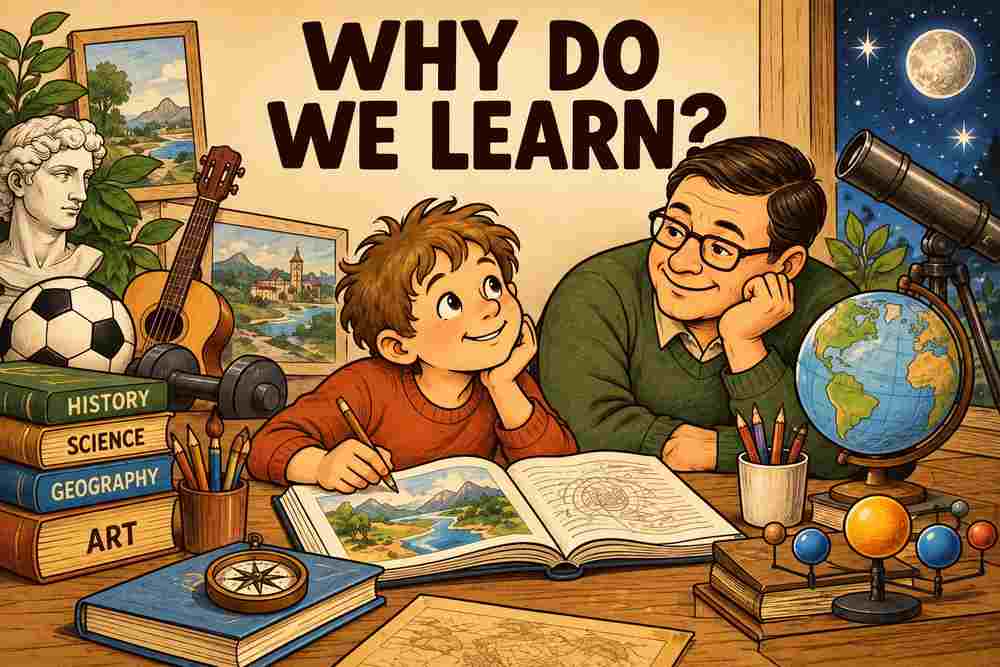
The first question a person should ask before taking any serious action is disarmingly simple: why am I doing this? Whether we realize it or not, that question follows almost everything we do. We study, work, build relationships, train, earn money, raise children, and all of it has a purpose. When it comes to education, the question of purpose matters especially deeply, because education consumes an enormous part of a human life.
First comes kindergarten, then school, then university, followed by courses, training, and professional retraining. We spend almost our entire lives learning, constantly mastering something new. We are taught to read and write, to calculate and to understand how nature and society work. The worlds of literature, music, history, and art are opened before us. We are taught to distinguish what is beautiful from what is ugly , what is noble from what is base . Around a child stand adults who have already travelled part of this road. They help broaden the child's picture of the world, face difficulties, overcome limitations, compare, doubt, verify, and draw independent conclusions. This, at least to a considerable extent, was how the purpose of education was understood in the Soviet tradition: school was expected not merely to transmit a certain body of knowledge, but to raise a person with worthy values and sound principles .
But gradually, the purpose of education began to sound much simpler: study hard and you will get into a good university; get a good profession; build a career; earn a lot of money; and then everything will be fine. There is common sense in this logic. Money genuinely matters. Financial stability removes an enormous number of problems and gives a person freedom of choice. But money alone is nowhere near enough for a happy life.
So what is happiness, anyway?
Look a little deeper and it becomes clear that almost everything people strive for is ultimately connected to the desire to be happy . But what is happiness? For one person, it is a delicious meal after a hard day. For another, it is reaching the summit of Everest after years of preparation. Someone may feel profound pleasure simply spending an evening with family. Someone else needs to build a company, write a book, run a marathon, or finally wrap their mind around quantum physics.
All of these experiences bring satisfaction, but their intensity, depth, duration, and price are radically different. Pleasure can be almost instantaneous: eat a dessert, watch a short video, buy something new. Or you can spend years moving toward a goal, enduring setbacks, training, studying, denying yourself easy comforts, and finally achieving something that once seemed impossible. Everest is only a metaphor here. A person can have as many such "Everests" as life allows.
Learn to play a musical instrument. Master a foreign language. Build a strong body. Create a business. Become a good doctor. Write a program. Learn to paint. Understand philosophy. Raise a child well, and so on. Most forms of deep human satisfaction do not belong to the category of "quick and easy." And this is precisely where education takes on an entirely different meaning.
Education should teach us not only to know, but to understand
One of the most important jobs of parents and schools is to teach a child to understand how the world works and how results are achieved within it. Not simply to hand over a collection of facts, but to reveal the mechanics of moving toward a goal. Suppose a child wants to learn to do fifteen pull-ups. He tries once, twice, three times, fails, and may very quickly decide: "I guess this just isn't for me." But the problem may have nothing to do with his abilities. Perhaps he simply does not know how training works: how many sets to do, how many repetitions, how long to rest, which supporting muscles to strengthen, how to increase the load, and how to recover.
Show him the right method, and after a while those impossible fifteen pull-ups become an entirely realistic goal. And something far more important than physical progress happens here. The child gains an experience: "I couldn't do it, then I learned. I wasn't able, then I became able. It was difficult, then I figured it out. I worked systematically, and I got a result." A thoughtful parent or teacher should pause at exactly this moment and draw the child's attention to the process itself:
Look at how it happened:
There was a goal.
There was a theory.
There was discipline.
There was consistent effort.
There were mistakes.
There were adjustments.
And now there is a result.
You did it yourself. Which means you can do it.
Then the same principle can be carried into another field. Mathematics was difficult, so we applied a proven strategy and worked it out. Couldn't swim? Same technology, learned to swim. Afraid of public speaking? Started speaking in public. Couldn't understand English? Followed the process and gradually began to speak. The child starts to recognize a pattern: results are not magic, nor are they an inborn gift reserved for a chosen few. Very often, results are simply the consequence of a well-designed process.
This is an extraordinarily important discovery. Because the opposite belief sounds like this: "I can't do it, so I must be incapable." . And that is one of the most destructive ideas a person can carry into adult life.
But knowing how to achieve is not enough
There is another side to the equation. Teach a person to achieve goals efficiently without giving him a moral framework, and you may produce not a strong human being, but a highly effective monster. Technique without values can easily collapse into the principle that the end justifies the means. So education is not only about asking, "How do I get what I want?" There are other questions: What is actually worth pursuing, and what price is acceptable to pay for it? What is right and what is wrong? Where is the line between personal benefit and responsibility toward others?
A child needs more than the ability to win. He needs a system of coordinates within which that victory has meaning.
We must learn to enjoy not only the result, but the process
There is another danger. A life can be built as an endless race toward the next summit. Exam. University. Job. Promotion. Money. Apartment. Car. Another promotion. Another apartment. Another goal. Every achievement delivers a brief flash of joy, and almost immediately a new point appears on the horizon. If a person cannot enjoy the process of moving toward a goal, life risks becoming one long stretch of tension, interrupted by brief flashes of joy when another victory finally arrives.
That is why a child must be taught not only to achieve, but to live inside the process. To enjoy the training, not only the medal. The reading, not only the grade. The investigation, not only the correct answer. The music, not only the concert. The road, not only the summit. And here we arrive at an even more difficult part of education: the ability to see the world.
We see the world through a lens
We never perceive reality in a completely unfiltered way. Between us and the world there is always a certain system of ideas, a paradigm. Marxism proposes that historical processes be viewed primarily through the struggle between classes. Freud directs attention toward the unconscious, repressed desires, and sexual energy (libido). The scientific picture of the world describes the Universe as the outcome of natural processes that travelled an immense road from elementary particles and inorganic matter to life, consciousness, and humanity.
Religious systems offer their own answers to questions of meaning, good, evil, life, and death. Philosophical schools answer those questions in their own ways. Stoicism offers one view of life, Buddhism another, Christianity a third, existentialism a fourth. What matters here is not rushing to choose the "correct" system, but becoming acquainted with different ways of seeing the world. You cannot choose something if you do not even know it exists.
To have a genuine choice, a person needs exposure to as many serious systems of thought as reasonably possible, while developing a kind of intellectual organ of perception capable of understanding them. From this perspective, mathematics, physics, chemistry, history, geography, and so on are also kinds of paradigms, ways of seeing the world and the harmony within it. This is not easy. It takes time and effort. But it is worth it.
The ability to see must also be trained
We often imagine that it is enough to show someone something great and they will automatically feel its greatness. That is not how it works. Bring an unprepared person into the Hermitage, and they will see paintings, but what those paintings awaken in them will be very different from what they awaken in someone who has studied art. A prepared viewer sees an era, a school, composition, technique, symbols, and the artist's influence on generations that followed. Physically, both people are looking at the same canvas, yet they are seeing entirely different worlds and, accordingly, experiencing entirely different emotions.
The same is true of music. To one person, Vivaldi is simply another melody among the thousands of sounds that pass through their ears every day. To another, it is structure, period, tension, movement, a dialogue between instruments, a recognizable musical language. Kant's categorical imperative may sound like a bizarre combination of words to the uninitiated, while Schrödinger's cat may seem like an absurd story about an unfortunate animal in a box. Yet behind these ideas stand vast intellectual structures. Understanding them is difficult, but it can bring immense moral and intellectual pleasure.
The ability to understand difficult things does not appear by itself. It must be developed, just as physical and intellectual strength must be developed. So must the ability to delight in beauty, to see cause and effect, to notice contradictions, and to ask good questions.
Simplicity is not a vice in itself
There is nothing wrong with being a simple person. The problem begins when simplicity conceals an absence of choice. When a person has too few ways to enjoy life, too few interests and sources of pleasure beyond food, shopping, alcohol, social media, endless entertainment, and other forms of fast dopamine reward. When every discomfort is something to be silenced immediately with another dose of pleasure rather than experienced, understood, and worked through. The desire for happiness does not disappear. But the poorer a person's toolkit for reaching it, the more often they reach for the crudest, fastest, and most accessible tools.
Then the principle of "like attracts like" begins to operate: people with similar lifestyles find one another and gather supposedly "around shared interests," though often precisely because genuine interests are missing. In such an environment, weaknesses stop being perceived as weaknesses. They become normal, receive mutual approval, and grow stronger through the constant exchange of experience and excuses. Hence the endless scrolling, intoxication, gambling, overeating, and constant hunger for fresh stimulation.
The richer a person's inner world, the more sources of pleasure become available. Joy can come from sport, conversation, books, music, travel, work, discovery, craftsmanship, creation, family, nature, philosophy. This is one of the strongest arguments for a broad education.
Health is the foundation
But no intellectual construction can cancel a simple biological reality: it is difficult to be happy in a body that is constantly hurting. Education should therefore include an understanding of one's own body and the processes taking place within it. A person should know, at least in broad terms, how the body works. The body needs physical exercise - so it makes sense to understand the fundamentals of training theory: load, recovery, adaptation, progression, and movement technique.
The body needs nutrition - so we need basic nutritional literacy: what proteins, fats, and carbohydrates are; why the body needs fiber, vitamins, and minerals; how energy balance works. And then there is one utterly practical skill: being able to cook decent food for yourself. Not restaurant masterpieces, but a few dozen simple, healthy dishes that keep a person from being completely dependent on delivery, processed convenience foods, and somebody else's cooking, which may be delicious but is often unhealthy.
We also need to understand our own minds. To know how to calm ourselves. To tolerate stress. To possess at least the simplest techniques of breathing, meditation, and focused attention. To understand that our inner state can also be regulated and trained. And finally, a person needs a worldview paradigm that works for them, a system of coordinates within which they can understand themselves, their life, their values, and the direction in which they are moving. But to choose such a system consciously, you must first discover that different systems exist at all.
What is happening to school?
Modern schools try to pour a colossal volume of information into a child. Many subjects are studied at once. Each has a curriculum. The teacher is required to cover it. There are tests, standards, reports, examinations. The result is a paradox: the more information the system tries to transmit, the less of it remains. The child's mind simply becomes overloaded. A natural defensive strategy appears: pass it - forget it .
Today, formulas are memorized. Tomorrow, there is a test. A week later, most of the material has vanished. Then comes a new topic. Then another. Information often exists as isolated fragments, barely connected to one another. Physics over here. History over there. Biology somewhere else. Literature in another box entirely. The child rarely sees the larger picture. Yet knowledge becomes truly valuable precisely when connections begin to form. Every teacher has a curriculum that must be completed. That curriculum is designed for a certain imaginary average diligent student, but children are different.
They think at different speeds. They have different interests, temperaments, memories, abilities, and levels of maturity. One child may understand in ten minutes what takes another two hours. Yet the second may effortlessly do something the first finds painfully difficult. By its very nature, mass general education struggles to deal well with this reality.
And there is another factor - the environment
Human beings are profoundly shaped by their environment. Sometimes the influence of school and peers becomes even stronger than that of parents, especially when parents take a passive position: "I'm not a teacher. The school is supposed to teach them everything!". In any large group, children inevitably arrive with radically different family values and models of behavior. One brings curiosity and interest. Another brings aggression. Another contempt for learning. Another a culture of humiliating the weak.
Some begin building their own hierarchy through bullying, manipulation, and pressure. Schools can find it extraordinarily difficult to confront this systematically. As a result, a child receives two systems of values at once. The official one says: study, grow, be disciplined. The unofficial adolescent culture may say something entirely different: don't try too hard, don't stand out, mock the top student, enjoy yourself now. Add TikTok, short-form video, an endless stream of stimulation, and the habit of instant dopamine rewards. Gradually, an extremely dangerous idea takes root: studying is bad, leisure is good.
So what are we left with?
Large classes. Radically different children. An overloaded curriculum. Teachers bound by reporting requirements and standards. A constant battle with social media and digital entertainment for the child's attention. An examination system that inevitably pushes toward drilling for tests rather than understanding the substance. A torrent of information that never quite assembles itself into a coherent picture of the world. And parents hoping that school will somehow solve the task of shaping a human being all by itself.
Most likely, it will not. Not because teachers are bad. But because a mass education system simply does not have the physical capacity to work deeply with every individual child and tailor methods to that child's particular characteristics in order to produce the best possible result.
So what do we do?
We start with ourselves. That may be the most uncomfortable conclusion of all. A child's education cannot be completely delegated to school. The parents have to begin. And not by hunting for the "perfect school," but by changing their own relationship with knowledge. We need to become curious about the world again. Ask questions. Why is the sky blue? Why does an airplane fly? Why do some countries become rich while others remain poor? Why do some people gain muscle easily while others struggle? Why did the French Revolution happen? Why do we sleep? What is inflation? Why do people believe in different religions? What is consciousness? Why don't antibiotics work against viruses? And then we look for answers together with the child. Today we have a tool that previous generations simply did not possess: AI chat. You can argue with it. Check its answers. Ask it to explain a difficult concept first to an adult, then to a ten-year-old child. Compare two theories. Hunt for errors.
Ask for arguments on both sides. Build thought experiments. And then, crucially, switch on your own mind: verify important facts, compare sources, take the answer apart logically. Then the chat stops being a machine that spits out ready-made solutions and becomes an intellectual training ground.
Children tend to copy their parents, and when parents constantly question, verify, and think things through, children begin doing the same. An ordinary question over dinner can grow into an hour-long conversation about physics, history, medicine, or philosophy.
Gradually, this stops feeling like "study" and becomes a way of spending time together. And that kind of time is genuinely memorable.
A child should see not an all-knowing adult, but an adult who is still learning
It is immensely valuable for a child to see that Mom or Dad does not know everything either, and is not afraid of that fact. "I don't know. Let's figure it out." That is one of the best models an adult can offer a child. The child begins to understand that ignorance is not a sign of stupidity. Ignorance is the starting point of inquiry. You can open a book, watch a lecture, ask an expert, check it with a chat, compare sources, run an experiment, and find an answer.
This creates a completely different relationship with the world. Not fear: "I don't know this." But curiosity: "Interesting. How does it work?" That approach develops analytical thinking, which can protect a person from countless mistakes.
This kind of person is harder to manipulate
They do not rush to divide everything into primitive categories of "good" and "bad." They clarify definitions. Ask what exactly is meant. Look for the mechanism, the principle underneath. Test cause and effect. If an advertisement says, for example, "Our incredible new healthy ketchup," they do not have to believe it automatically, nor reject it automatically. They can read the ingredients. Examine them one by one. Assess their quality. And ask a simple question: if almost every component of a product is unhealthy, how does the product as a whole suddenly become healthy?
It is an elementary example, but the same principle applies to politics, advertising, ideologies, investing, medicine, social media, and thousands of other things. Automatic trust or distrust gives way to investigation.
The central task is to raise a person who finds life interesting
Ultimately, the purpose of education, in my view, is far broader than a good job and a high salary. We need to help a child build an inner system that allows them to live a good, rich, interesting life. Ideally, that means giving them several things: A healthy body and an understanding of how to care for it. The ability to set goals and achieve them. The experience of overcoming difficulty. A moral compass. The skill of critical thinking. The ability to see beauty and take pleasure in it.
A person needs to learn to see the world as a whole, in all the richness of its interconnections. That means being curious about knowledge, knowing how to learn independently, understanding one's own mind, understanding the rules by which society operates (behavior, etiquette, and so on), and learning to enjoy not only the result, but the process itself.
And above all, there should be an inner conviction: not "I can do anything," but "I can figure it out". More precisely: "If I ever need this, I can understand how it works, find the knowledge, master the method, and try. I've figured out hundreds of things before. I'll figure this one out too."
For a child to reach that state, there is little point in waiting for the perfect teacher, the perfect school, or the perfect education reform. You have to set the example yourself. Read yourself. Train yourself. Ask questions yourself. Change your mind when stronger arguments appear. Keep learning. Admit your mistakes. It is a long and demanding investment. But it may be one of the most important investments a parent can ever make.
Because the result is not merely an educated child. It is a human being who knows how to think, learn, choose, act, and understand themselves. And that gives them a far greater chance of becoming genuinely happy.
Другие статьи автора:
- Правила игры: как научить ребенка понимать мир вокруг
- Наказание как форма заботы: зачем детям нужны границы
- Как воспитывать детей: никакой «волшебной таблетки», только ясные правила и честные последствия
- Образование и критическое мышление: зачем нам менять подход
- Когда знание превращается в наказание
Обучаю разговорному английскому. Помогу Вам подготовиться к TOEFL или ЕГЭ.
За полгода вывожу ученика начального уровня на уровень уверенного общения, свободного выражения своих мыслей. Специализируюсь на экспресс-методах обучения.
- ИгорьRead more
Анонс статей
- Учим английский дома! Или как самостоятельно обучить ребенка английскому языку
- TOP 120 Неправильных глаголов по частоте испльзования №2
- 19 ПРАВИЛ ПУНКТУАЦИИ В АНГЛИЙСКОМ ЯЗЫКЕ
- С какого возраста начинать изучать английский язык: 2 мнения
- WHY DO WE LEARN?
- ПРАВИЛА ИГРЫ, О КОТОРЫХ ДЕТЯМ НИКТО НЕ ОБЪЯСНИЛ
- Пишем сочинение «на отлично» на любую тему и на любом языке, с использованием подхода «Материальное-Духовное»
- Как воодушевить детей изучать английский язык ?
- Универсальный метод написания сочинений по ЕГЭ, TOELF или IELTS: лайфхак «Утверждение-Пример»
- Как легко запомнить 100 английских слов в день: 6 эффективных способов
- КАК ВОСПИТАТЬ МЫШЛЕНИЕ, КОТОРОЕ НЕЛЬЗЯ ОБМАНУТЬ
- Использование карточек в обучении детей
 Как правильно изучать английский язык по карточкам (статьи)